



Blog by Steven Ziolkowski, R&D and Consultant Engineer at Kinewell.
 Steven Ziolkowski is a dedicated and creative engineer with extensive knowledge of model-based engineering, data analysis and power systems. He undertakes international consultancy utilising the KLOC software for Kinewell to carry out inter-array cable layout design and electrical loss studies. He has delivered >£52m of value through 7 GW of offshore wind project consultancy across European, Japanese and US markets to date through developing a comprehensive cost model of the offshore wind farm incorporating both CAPEX and OPEX considerations, upon which the cable layout was optimised to deliver substantial cost savings for the project. Steve leads on KLOC software training and support for both clients and staff, as well as state-of-the-art research and development projects making use of machine learning algorithms and python proficiency. Steve demonstrates rigourous testing of new features to ensure quality. Steve has a strong academic record from his master’s degree in Electrical and Electronic Engineering from Newcastle University and practical application from industrial experience with Northern Powergrid and Siemens energy.
It’s a common question I get asked by our clients. And I’m going to give you an answer that is hopefully a bit better than ‘it depends’. Although, that is the answer (spoilers).
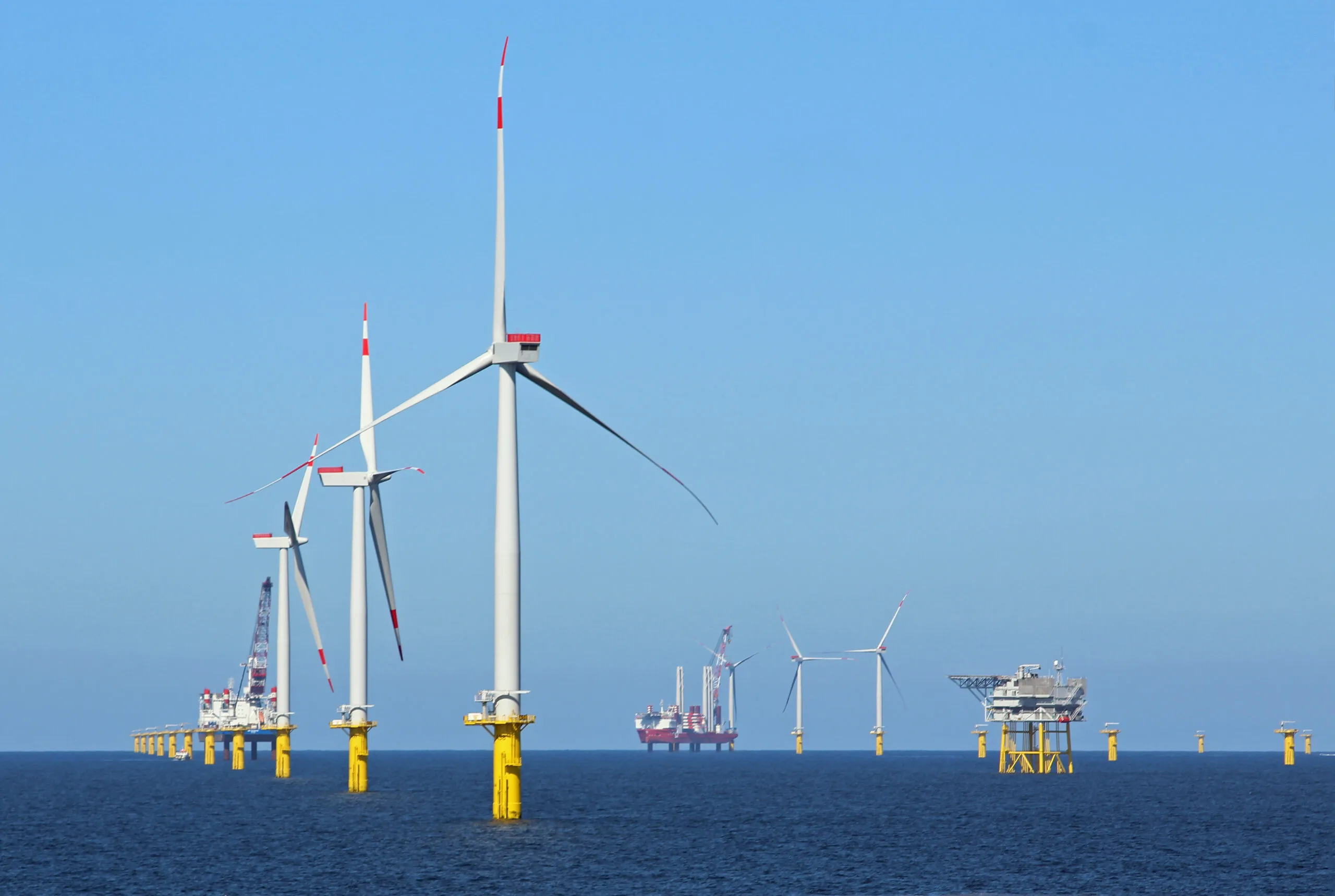
Let’s use an example. You are designing an offshore wind farm of 60 turbines with 1 substation. Each turbine has a total height around 260-280m, not far off the size of the Eiffel tower, and their blades are typically 115-120m; longer than a football pitch. So, you need to connect these 60 Eiffel towers to shore somehow.
- Instead of using millions of meters of subsea cable to connect each individually to shore, we collect the cables to a close point called a substation.
- Instead of individually connecting 60 cables to the substation, we can connect them to each other, in a daisy chain, where cables get gradually thicker as we get closer to the substation. So now we only have say 10 or 12 cables linking into the substation
- all that power get transported by a really big cable from the substation to the shore (only 1 or 2, phew).
Now, here it comes – where should I place the substation?
If you said the center of the wind farm, it’s a great guess. You would generally have shorter thick cables, subsequently lower thermal losses, potentially more easily balancing strings and reducing the complexity of cable routing. Indeed, Kinewell’s KLOC inter-array cable software does sometimes find that the centre is the best place to site the substation. However, before we lock-in our final answer, I’d like to explore 3 other aspects: hard-limits, bias and cost modelling.
Hard-limits
We have to firstly recognise there are some things that are simply out of our control. A substation might have to be placed in a certain location for legislative reasons. It’s important that safety, and access for maintenance and operations by crew, are addressed before any sort of optimisation can be postulated.
Additionally, there might be certain obstacles that are no-go areas for cables to enter, such as certain pipelines, or unexploded ordnance devices (UXOs). This further reduces the margins of the achievable value, or what we call the solution space in inter-array designs, but these are non-negotiable terms that must be incorporated.
Bias
Humans love symmetry and balance and so we naturally play dot-to-dot with an artistic flair. I normally see engineers draw: straight lines, parallel lines, everything as symmetrical as possible. I am not by any means downplaying fellow engineers who are drawing designs manually – I also include myself in this demographic.
Contrast this to the AI: whenever I go head-to-head with KLOC, even though I have known my adversary with 6 years of its inner workings, I’m still coming in second place overwhelmingly. And whenever KLOC has done something seemingly illogical or wrong, I only have to glance over my inputs and assumptions to realise it was an error in my modelling. The bias of symmetry and balance might (and often does) influence where you place the substation and subsequently how you design the network, which is often sub-optimal.
Cost modelling
Kinewell support team (Me): Do you want to cross this obstacle? KLOC user: No. Kinewell support team (Me): Can you cross this obstacle? KLOC user: I suppose.
To achieve an optimal design, we should consider everything that is possible.
So we can add cost penalties for pipelines across the windfarm. There’s also that really big cable from substation to shore, which is thick, and expensive, so it might be advantageous to reduce that; to balance that cost against inter-array savings. We also must, as accurately as possible, model the costs that impact on the capital or operating costs of the subsea cables. For example, the rocky areas in the seabed make installation a lot more expensive for cables, which will impact decision of entering/crossing this area.
And what about the 10 or so cable types from the manufacturer that could be technically used? They will have a price per meter, an ampacity that can gives a certain number of turbines they can be connected to, and associated thermal loss depending on their electrical characteristics.
After consideration of these cost features, it becomes increasingly clear that many variables should be tested in designs before an optimised solution can be realised.
So would you stick with the center of the windfarm?
If so, is not a bad start – placing your substation in the center is generally supported in the ideal case of just regular grid-shaped wind farm of 50-80 turbines, 1 substation, and a few cables to pick from. But when considering the reality of hard-limits and cost modelling of the lease area, not to mention the option of a second, third, fourth substation, the problem becomes bespoke, and its very difficult to ensure you have an optimised design without an inter-array optimiser by your side, like KLOC.
Learn more about KLOC or get in touch to schedule your free demo.