




Blog by Dr Jiaxin Zhang, Modelling and Optimisation Engineer at Kinewell.
Dr Zhang specialises in the development and implementation of advanced algorithms that drive efficiency and unlock new functionality for users of Kinewell’s offshore wind software suite. His work focuses on creating intelligent software solutions that harness AI and optimisation to solve complex, real-world design and operational problems.
The summer of 2026 has brought a new wave of offshore wind development, with new auction rounds, re-tenders, and many countries actively redesigning their frameworks. The industry seems reinvigorated – but key challenges around cost, timelines, and risk remain.
As Fugro’s latest outlook shows, uncertainty remains high due to ongoing conflicts, supply chain disruptions, and rising costs across the board. As a result, the start-up of new projects remains slow, with major recovery not expected until the second half of 2027.
With that timeline in mind, now is the right moment to focus on solutions that tackle these challenges directly. As the sector scales, the industry is moving decisively towards digital tools for offshore wind project de-risking. This article looks at three ways software can help: fast, adaptive layout design; wake effect modelling; and operational risk reduction.
Design fast, design well, de-risk early
The biggest issue facing the industry remains reducing project cost, especially for later-stage projects like Morgan in the Irish Sea.
Morgan is a technically attractive but challenging site with complex environmental conditions, which creates the need for detailed, adaptive constraint modelling in turbine and inter-array cable (IAC) layout design.
Kinewell’s software suite is built exactly to tackle challenges like this. Kinewell Layout Optimisation for Windfarm Design (KLOWD) can quickly generate turbine and inter-array cable layout options with smart substation positioning. KLOWD aligns designs with soft and hard constraints – no-go areas, linear obstacles, and specific cost zones – while targeting CAPEX and OPEX savings and maximising the lifetime value of a project.
In a re-tendered project like Morgan, developers face accelerated timelines, legal complexity, and bankability pressures. A rapidly and holistically optimised layout can be the difference between a marginal bid and a compelling one.
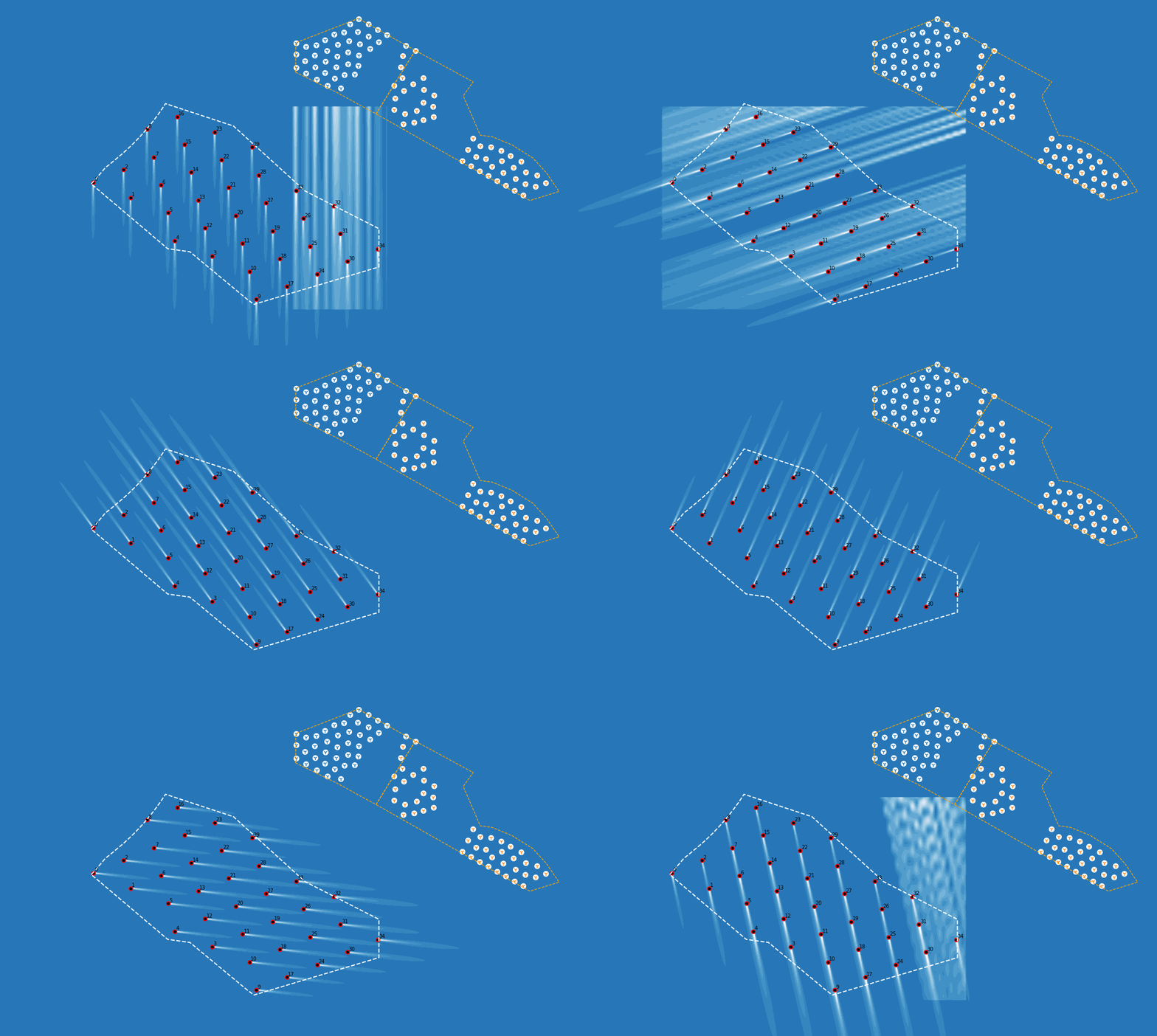
Simulated wake effects at Morgan under changing wind directions, showing how turbine wakes interact within the site and with neighbouring wind farms.
Neighbouring Wind Farm Effects
A growing concern for developers is inter-farm wake effects. As sea space becomes more congested, projects in clusters risk being negatively affected by neighbouring wind farms.
Morgan and Morecambe sit in a shared Irish Sea development zone, so turbine layout decisions and revenue assumptions for each require additional consideration of the other.
KWOTA (Kinewell Wake-Optimised Turbine Arrangement), also part of Kinewell’s software suite, helps users find wake-optimised turbine layouts quickly. KWOTA captures the impact of both inter-farm and intra-farm wakes on wind yield and energy production, letting developers rapidly evaluate and optimise turbine layouts while accounting for nearby projects – accelerating and de-risking early-stage design.
The goal isn’t complexity for its own sake. It’s ensuring revenue cases are robust, defensible, and grounded in the physical reality of increasingly crowded sea space.
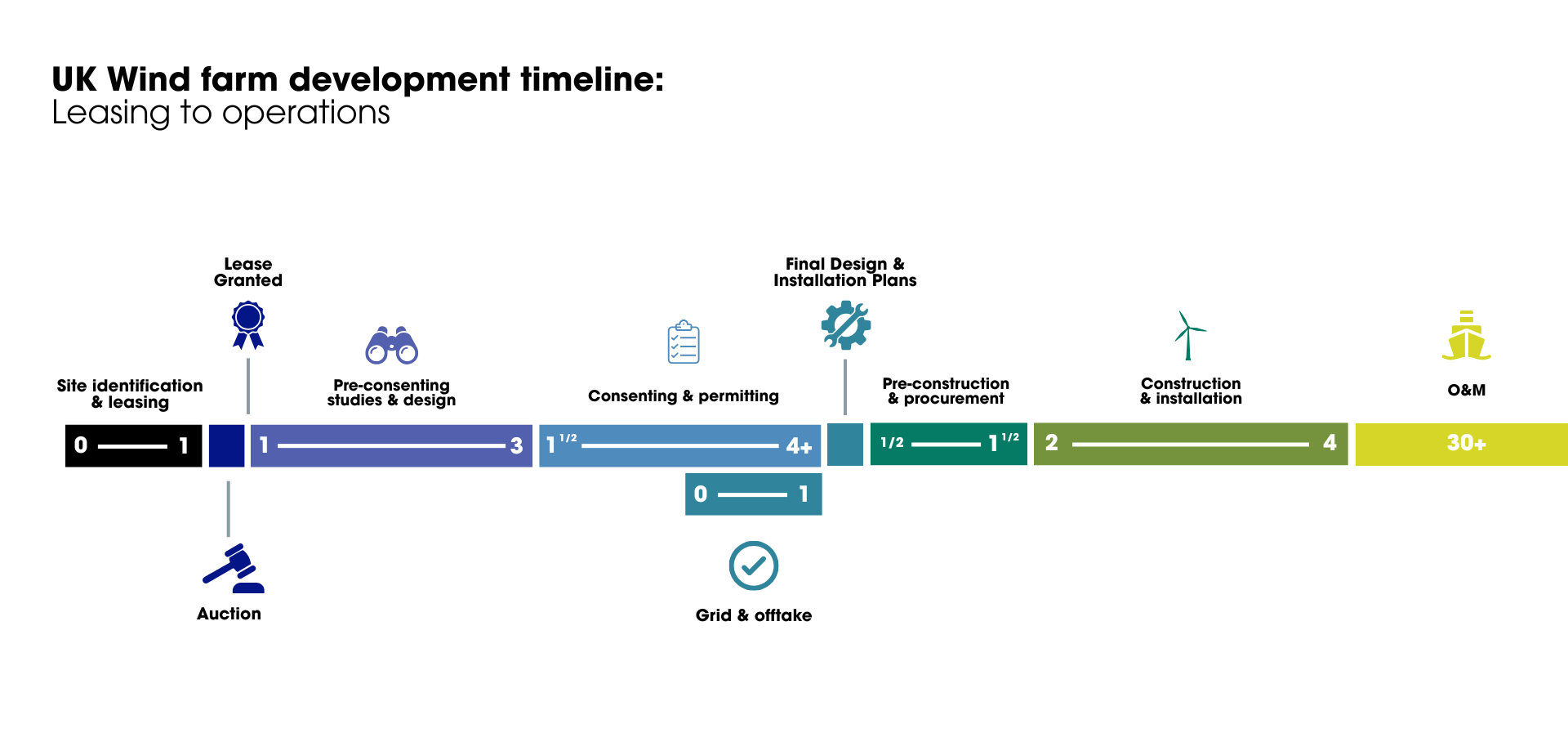
UK Wind farm development timeline – Leasing to operations
Operational and Schedule De-Risking
Optimised design and yield predictions are only part of the story. Once a project moves towards construction and operation, delays driven by weather windows, vessel availability and installation sequencing can drastically erode project returns.
Our new ForeCoast Marine® tool supports installation planning and weather window modelling, incorporating metocean conditions and logistic interactions into construction schedules. ForeCoast Marine® can also help evaluate O&M strategies and the downtime impact of various maintenance events throughout project lifetime.
Making the Next Wave Happen
The next wave of UK offshore wind will be defined by the industry’s ability to de-risk projects efficiently and credibly. That’s how a pipeline of “almost there” projects becomes a wave of projects that actually get built.
The Kinewell team is working on further solutions to help optimise and de-risk offshore wind projects, and we’re looking forward to sharing more about these innovations soon.
Talk to Us About De-Risking Your Offshore Wind Project
If you’d like to explore how KLOWD, KWOTA, or Kinewell’s wider software suite can support your bid or development strategy, we’d be glad to talk.