






5 min.
average design time
fixed + floating
both wind farm types supported
20%
typical cable CAPEX saving*
*over the project lifecycle
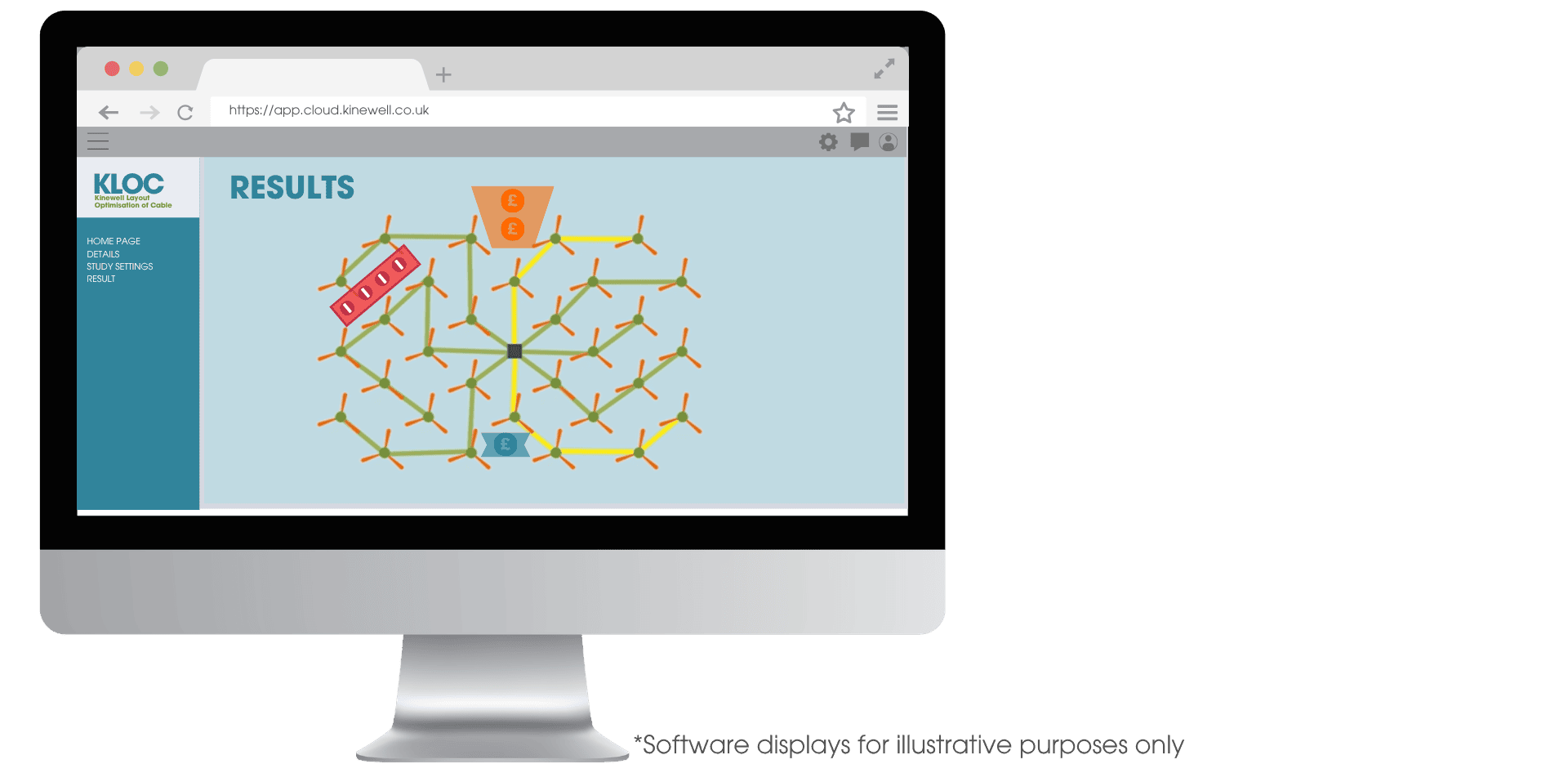
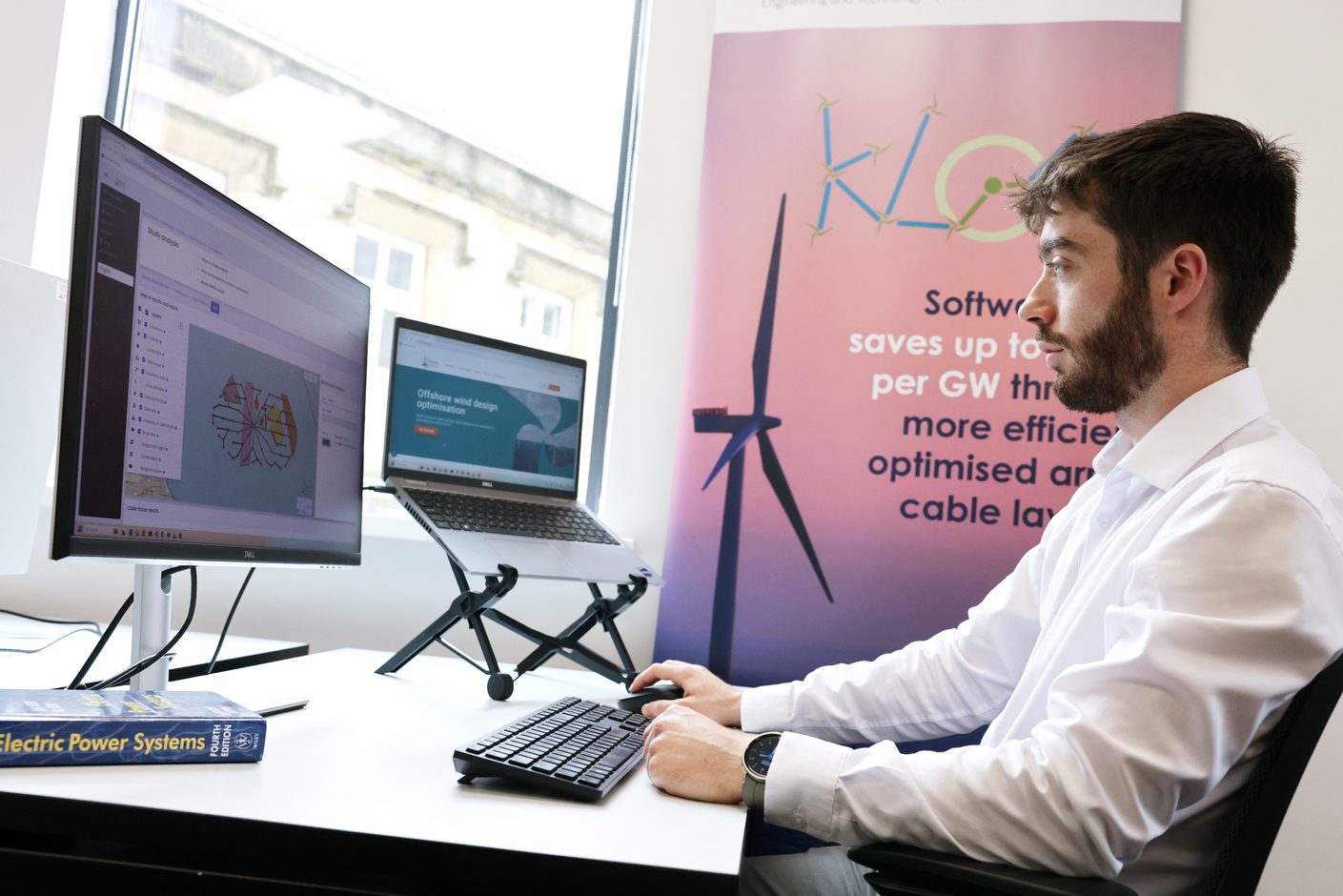
KLOC is an advanced offshore wind cable layout optimisation tool that rapidly evaluates a vast range of possible inter-array cable configurations to identify economically optimised solutions for your wind farm.
Using advanced mathematics, super computing and AI, KLOC helps engineering and design teams optimise cable routing, cable selection and offshore substation locations while accounting for the technical, geographical and economic constraints that shape a real offshore wind project.
Whether you are developing a fixed-bottom or floating offshore wind farm, KLOC gives your team the insight to make better electrical system decisions earlier in the project lifecycle.
Every offshore wind project has different priorities. You may need to minimise CAPEX, reduce whole-life costs, maximise energy yield, use less cable or balance several objectives at once. KLOC gives you the flexibility to optimise your inter-array cable system around your project’s specific requirements.
With optimisation studies completed in around five minutes, KLOC makes it practical to investigate thousands of potential configurations and identify opportunities that conventional design approaches may miss.
Why KLOC?

Accelerate timelines
Generate layouts in minutes, rather than hours or days.

Reduce costs
Typically save around 20% of inter-array cable system CAPEX over the project lifetime.
Maximise energy yield
Optimise cable configurations to reduce electrical losses.

Less cable & resources
Reduce cable length and material requirements.

Reduce project risk
Test “what if” scenarios to identify potential issues early.
Flexible optimisation for complex projects
KLOC lets you define your objectives and constraints, then rapidly explores a vast range of possible configurations to find solutions aligned with your priorities. Whether your priority is CAPEX, whole-life cost, energy yield, resource efficiency or a combination of objectives, KLOC helps you find the solution that works for your project.

From planning to detailed design
KLOC can support optimisation throughout the project lifecycle, from early-stage feasibility and concept design through to FEED, detailed engineering, procurement and value engineering.
By making optimisation faster and more flexible, KLOC helps teams understand the impact of design decisions while there is still time to influence the project.
Who is it for?

Offshore wind developers

Renewable infrastructure planners

Electrical & energy systems engineers

Cable suppliers & contractors

Project managers & consultants
Optimisation backed by real-world offshore wind engineering expertise
KLOC has been developed by experienced offshore wind engineers and project developers at Kinewell, ensuring the software reflects real project constraints, practical installation considerations and the realities of delivering offshore wind projects at scale.
This means the optimisation is not purely theoretical. It is grounded in real-world offshore wind engineering judgement, helping teams explore practical, buildable solutions while reducing manual design iterations and the risk of late-stage changes.
Use KLOC in-house or work with our experts
KLOC is available as a software licence for in-house use, giving engineering and development teams direct access to advanced cable layout optimisation within their own workflows.
When additional expertise or capacity is needed, Kinewell can apply KLOC through our offshore wind engineering consultancy services. Our team can support your engineers with complex optimisation studies, investigate challenging design problems, evaluate alternative solutions or provide additional capacity during busy project periods.
This gives you the flexibility to use KLOC independently when you have the capability in-house, or draw on Kinewell’s optimisation and engineering expertise when you need additional support.
KLOC has been applied across real offshore wind projects and used by organisations including SSE Renewables, Equinor, Parkwind and Xodus.
Key features
All features
Network & cable configuration
 User input cable type library User input cable type library |
Define custom cable types with properties such as cross-sectional area, ampacity, resistance, inductance, capacitance and purchase cost. |
| Static and dynamic cables |
Model static and dynamic cable types, including within the same network. |
| Parallel cables |
Model multiple cables laid together in the same trench. |
| Fixed-bottom and floating networks |
Design networks for fixed-bottom or floating wind farms. |
| Multiple substations |
Model more than one substation within a single wind farm (star networks support only one). |
| Substation electrical parameters |
Set substation frequency and nominal inter-array voltage. |
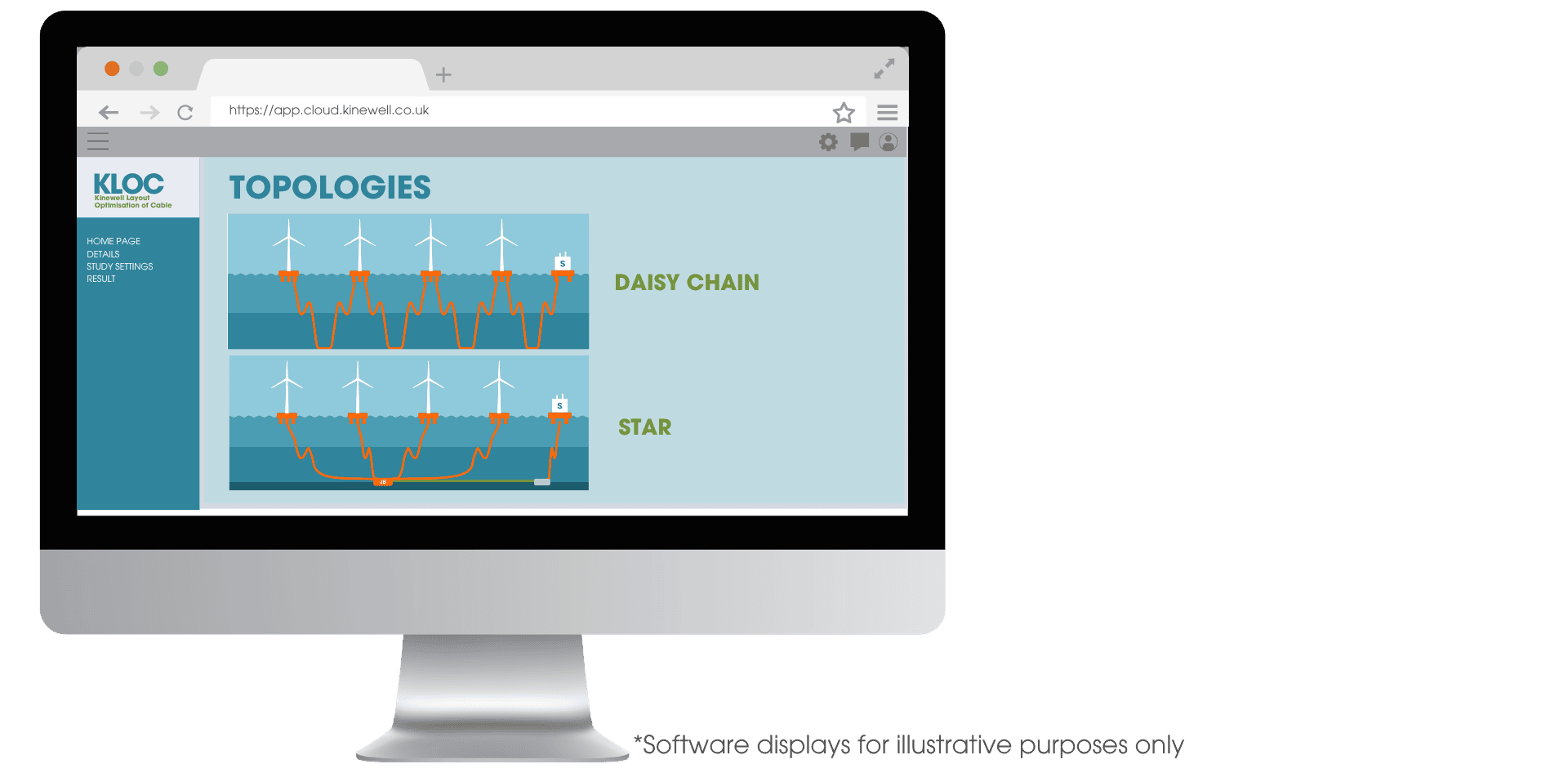
| Daisy chain network (floating) |
A radial network using dynamic cable to link turbines and the substation directly along each string. Only available where the substation is floating. |
| Star network (floating) |
Multiple turbines in a ‘cluster’ connect to a junction box by dynamic cable, and the junction box connects to the substation by static cable. KLOC configures the junction box locations and turbine groupings to minimise cost. Limited to one substation. |
| Radial and branched networks (fixed-bottom) |
Choose between radial or branched layouts for fixed-bottom wind farms. |
| Maximum string limits |
Set a maximum number of strings overall, and a maximum number of strings per substation. |
| Substation balancing |
Balance transformer loads and/or string connections evenly across substations. Not available for star networks. |
| Looping |
Add looped (normally open by default) connections that can reconnect isolated turbines after a cable failure, reducing lost energy. The user sets the maximum number of loops to consider. |
| Protection philosophy |
Choose the network protection philosophy: substation breakers, cable breakers, or manual isolation. |
| Redundant cable costing |
Include the cost of redundant cables in the design. |
Project & collaboration management
| Multiple projects per licence |
Create and manage multiple projects within a single licence. |
| Team access control |
Set access levels for team members on each project: no access, viewer, analyst or admin. |
| Project currency selection |
Choose a project’s currency from GBP, USD, JPY or EUR. |
| Project credit history |
View a log of credits used running studies, and credits remaining on the licence. |
Site constraints & spacial inputs
| Project coordinate reference system |
Set the coordinate reference system (CRS) used for a project. |
| Geographic input layers |
Apply values such as installation cost, cable de-rating, O&M cost or failure probability to specific shapes or areas of the site, or set a default value for the whole site. |
| Linear obstacles with crossing penalties |
Add linear obstacles with a cost penalty, discouraging (without completely forbidding) cable routes from crossing them. |
| No-go areas |
Define areas that cables cannot route through at all. |
| Auto-generated mooring exclusions |
Automatically generate no-go areas around each turbine based on mooring line angles and dimensions (for floating wind). |
| Auto-generated cable waypoints |
Automatically generate waypoints at each turbine so cables only enter at allowed angles. |
| Cable bending around no-go areas |
Account for cable bending radius and vessel turning radius when routing around no-go areas, avoiding unrealistically sharp turns. |
Optimisation engine
| Run optimisation |
Generate an optimised layout from scratch. |
| Run optimisation from current layout |
Generate an optimised layout starting from an imported or existing cable network. |
| Run cost model only |
Re-evaluate an existing layout using the cost model, without further optimisation. Not currently supported for looped networks. |
| Whole-system cost optimisation |
Optimises across the entire array cable network, rather than individual routes or components in isolation. |
Economic & cost modelling
| CAPEX-only or CAPEX+OPEX+revenue modelling |
Choose whether a study considers capital costs only, or capital costs alongside operating costs and revenue. |
| Configurable economic parameters |
Set parameters such as energy value, discount rate, wind farm lifetime, cost escalation rates, repair times and connection costs to tailor the cost model to a project. |
| Cable failure cost modelling |
Model the probability and cost impact of cable failures, with separate parameters for static and dynamic cables. |
Analysis & comparison tools
| Study comparison |
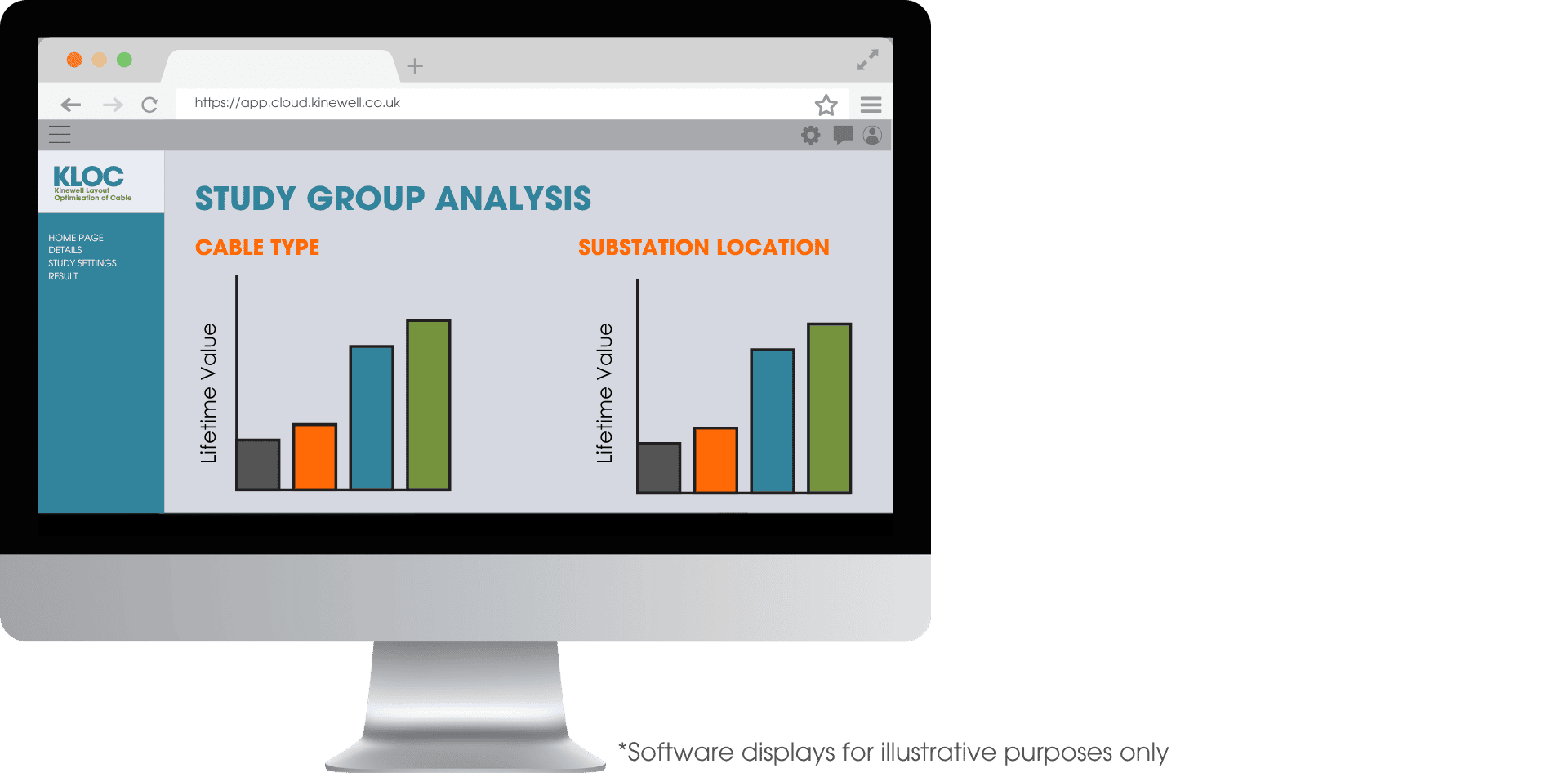
Compare completed studies against a range of metrics, such as lifetime value, displayed via bar chart. |
| Study groups (sensitivity analysis) |
Run multiple studies at once with systematically varied parameters, including substation location or considered cable types. |
| Cable layout heatmap |
Combine and weight cable layouts from multiple studies into a heatmap showing the most and least likely cable routes. |
| Substation placement heatmap |
Combine multiple proposed substation locations and their lifetime values into a heatmap showing the highest and lowest value areas for substation placement. |
Platform & usability
| Input validation |
Validation checks and error messages throughout the platform to catch invalid inputs. |
| Interactive map |
View and edit wind farm layouts and cable designs on an interactive map. |
| Web-based platform |
Access KLOC through a browser-based web application, with no specialist software needed. |
| Results summary and map views |
View key outputs on a results summary page, and the layout and cable breakdown on a map page, after a study has run. |
Use KLOC to
Optimise your cable design
 Optimise your cable layout
Choose the optimal set of cable types balancing standardisation with efficient tapering
Model power losses within the cables
Build redundancy into cable layouts using loops to see the value of energy export even when a cable fails
Design around seabed no-go areas such as UXO, pipelines and mooring lines
Compare designs visually
Understand cost and risk
Test cable costs against changing market conditions
Assess sensitivity to uncertain seabed conditions
Understand the value of energy losses
Evaluate the impact of cable failure
Assess FID applications
Explore different design options
Compare multiple substation locations
Balance substation loading
Test different cable philosophies
Model floating wind layouts
Compare daisy-chain and star configurations
Run what-if scenarios
Make better decisions earlier
Forecast cable and substation locations
Reduce the scope of seabed surveys
Support export route planning
Identify suitable cables for detailed quotations
Support competitive site auction bids
Support product and technology development
Assess cable parameters for project viability
Understand required cable cost and reliability
Evaluate cable losses and performance requirements
Assess junction box requirements
Support cable and component R&D
Flexible ways to use KLOC
Whether you want to build optimisation capability in-house, access our expertise or develop something tailored to your needs, KLOC can be delivered in the way that works best for your organisation.
Use it
Build optimisation capability in-house
Bring KLOC in-house with flexible licence options to suit your project requirements. Choose short-term or long-term access, with full training and ongoing support from our team, so you can make the most of KLOC within your own workflows.
Contact us to book your free discovery call.
Integrate it
Connect KLOC with your existing tools and workflows.
Integrate KLOC with your existing systems, data and processes through APIs, making advanced optimisation part of your wider engineering and design workflows.
Contact us to book your free discovery call.
Solve it
Access KLOC through Kinewell consultancy.
Let Kinewell apply KLOC and our offshore wind optimisation expertise to your challenge. We can carry out optimisation studies, investigate design options, benchmark existing solutions or support your engineering team with complex project decisions.
Learn more about our consultancy services.
Build it
Build on KLOC technology.
We can use KLOC’s underlying algorithms and optimisation technology to create solutions tailored to your requirements. We can adapt existing capabilities, add new modules and functionality, or develop entirely new applications to address specific challenges and workflows.
Explore what’s possible with custom development.